Cross-Platform Mobile App Architecture: Launching on iOS and Android on a Startup Budget
The Startup Dilemma: Dual Native vs. Cross-Platform
When an early-stage venture or growing enterprise sets out to build a mobile application, the engineering budget is always top of mind. In international technology hubs across the US, UK, and Europe, commissioning two completely separate native codebases—Swift for iOS and Kotlin for Android—frequently pushes development quotes beyond $60,000 to $100,000 before initial market validation.
Worse than the upfront capital expenditure is the operational drag:
- Two Engineering Teams: Coordinating feature parity between separate iOS and Android developers doubles management overhead.
- Divergent Bug Tracking: A critical bug resolved in the iOS sprint often requires an independent debugging cycle on Android.
- Delayed Time-to-Market: Product iterations and UI experiments take twice as long to deploy to the App Store and Google Play Store.
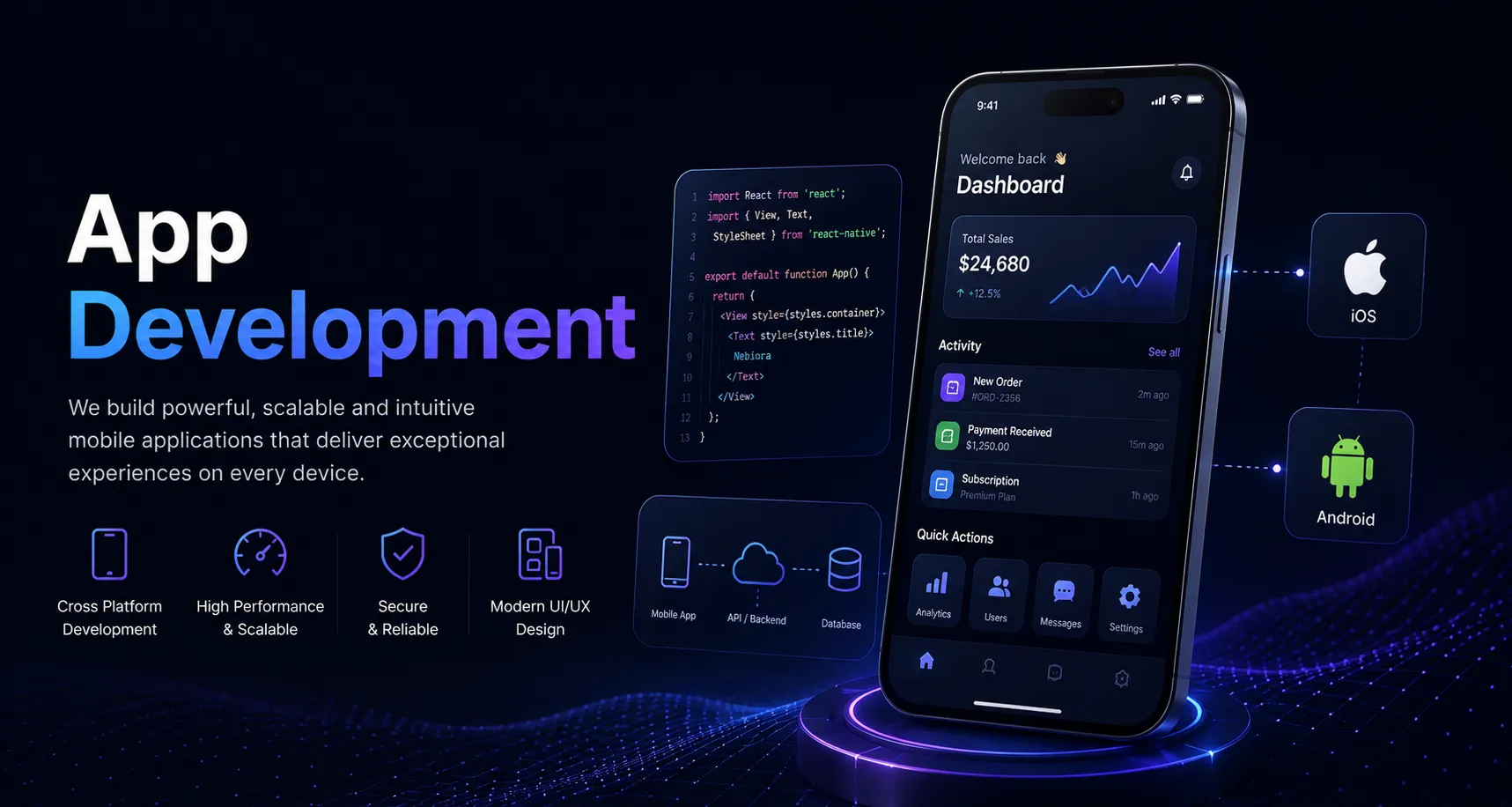
Fortunately, modern cross-platform engineering has matured exponentially. Today, frameworks like Flutter and React Native enable engineering teams to deliver pixel-perfect, 60fps applications across both platforms from a single unified codebase, reducing development expenditures by 40% to 50% without sacrificing speed or user experience.
Debunking the Myth: Are Cross-Platform Apps “Slower”?
A decade ago, early hybrid tools relied on embedded webviews, leading to sluggish scrolling and clunky gestures. That era is long gone.
Modern cross-platform frameworks compile directly to native arm64 machine code or utilize high-speed C++ rendering engines that bypass webviews entirely:
- Hardware-Accelerated Rendering: Interfaces are rendered directly onto GPU surfaces, providing fluid 60fps animations, physics-based gesture handling, and responsive micro-interactions.
- Native Platform Channels: Need biometric authentication (FaceID / Fingerprint), background geolocation, push notifications, or camera hardware access? Cross-platform engines communicate directly with underlying native APIs with zero perceivable latency.
- Consistent Design Language: Brand aesthetics, typography, and responsive component layouts look identical across hundreds of diverse device screen sizes and aspect ratios.
4 Core Architectural Principles for Scalable Mobile Apps
To ensure an application scales effortlessly as user acquisition grows from hundreds to hundreds of thousands of active users, software architects implement several foundational design patterns:
1. Offline-First State Synchronization
Network connectivity in the real world is unpredictable. Robust mobile architectures utilize local persistent storage (such as SQLite or encrypted key-value stores) so users can interact with app features, review data, and draft entries while offline. When an internet connection is re-established, a background worker synchronizes local changes with the central cloud database using deterministic conflict resolution.
2. Modular State Management
Decoupling the visual presentation layer from the business logic layer ensures testability. Using predictable unidirectional state patterns allows developers to isolate UI components, test edge cases in simulated sandboxes, and roll out new features without unintended regressions.
3. Resilient API Consumption & Caching
Mobile apps operate in diverse network conditions, from fiber Wi-Fi to congested mobile cellular towers. Implementing efficient HTTP caching, request retries with exponential backoff, and compressed data payloads (such as Protocol Buffers or compact JSON) protects battery health and optimizes data bandwidth.
4. Continuous Integration & Automated Store Deployment
Automating build pipelines ensures that every code commit is automatically tested, signed, and compiled into production-ready .ipa and .aab packages. This eliminates manual packaging errors and enables rapid hotfix distribution across both the Apple App Store and Google Play Store.
Strategic Evaluation: When to Choose Cross-Platform
| Criteria | Dual Native (Swift & Kotlin) | Modern Cross-Platform |
|---|---|---|
| Development Cost | High (Requires 2 dedicated codebases) | Optimal (Single shared codebase) |
| Time to Market | 4 to 8 months | 8 to 14 weeks |
| Maintenance Burden | Ongoing dual updates & dual QA | Unified testing and single sprint cycles |
| UI Consistency | Often diverges between platforms | Identical brand rendering across devices |
| Best For | AAA 3D games, custom kernel OS tools | SaaS extensions, e-commerce, consumer apps, B2B portals |
For 95% of consumer and B2B software products—including marketplaces, financial tracking tools, logistics coordination apps, and customer portals—cross-platform architecture delivers an unbeatable balance of velocity, financial efficiency, and aesthetic polish.
Partnering with Nebiora for Mobile Engineering
At Nebiora, we engineer clean, resilient mobile applications tailored to your business objectives. From initial wireframing and user experience architecture to cloud backend integration and official store publication, we manage the entire lifecycle with engineering precision.
Planning a new mobile app or looking to modernize an existing product? Connect with Nebiora to bring your mobile application to life.

Ready to Transform Your Business?
Let's talk about your project. Get a free consultation and a clear roadmap for building your next app, platform, or AI agent.
Get Your Free Consultation